




 Click it and Unblock the Notifications


Latest Updates
-
 Bharti Singh-Haarsh Limbachiyaa Welcome Second Child, Gender: Couple Welcome Their Second Baby, Duo Overjoyed - Report | Bharti Singh Gives Birth To Second Baby Boy | Gender Of Bharti Singh Haarsh Limbachiyaa Second Baby
 -
 Bharti Singh Welcomes Second Son: Joyous News for the Comedian and Her Family
 -
 Gold & Silver Rates Today in India: 22K, 24K, 18K & MCX Prices Fall After Continuous Rally; Check Latest Gold Rates in Chennai, Mumbai, Bangalore, Hyderabad, Ahmedabad & Other Cities on 19 December
 -
 Nick Jonas Dancing to Dhurandhar’s “Shararat” Song Goes Viral
 -
 From Consciousness To Cosmos: Understanding Reality Through The Vedic Lens
 -
 The Sunscreen Confusion: Expert Explains How to Choose What Actually Works in Indian Weather
 -
 On Goa Liberation Day 2025, A Look At How Freedom Shaped Goa Into A Celebrity-Favourite Retreat
 -
 Daily Horoscope, Dec 19, 2025: Libra to Pisces; Astrological Prediction for all Zodiac Signs
 -
 Paush Amavasya 2025: Do These Most Powerful Rituals For Closure On The Final Amavasya Of The Year
 -
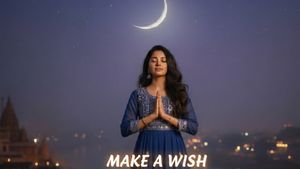 As The Last New Moon Of 2025 Approaches, Make A Wish Based On Your Rising Sign


Delhi 2050 AI Wedding Video Has Smog, Masks, Purifiers: Are AI-Generated Posts Going Viral For Right Reasons?

A stylised AI-generated video by influencer Shweta is making its rounds on social media: a wedding in Delhi, set in the year 2050. What looks like a familiar ceremony-mandap, guests, festivity is undercut by unsettling detail: many attendees are wearing masks, air‑purifiers are visibly arranged in the hall, and the skyline is veiled in smog. The contrast between tradition and a deteriorated environment creates a jarring image of how even joyful moments might change in a future marked by pollution.

From Fiction To Message: What The Imagery Conveys
By placing a joyous occasion in a dystopian backdrop, the video does more than entertain. It signals that pollution is not just an outdoor problem, it could seep into life's most cherished events. The masks and purifiers shift from accessory to necessity. The wedding becomes a metaphor: if even celebration needs filtration and protection, the stakes are high. While the video uses speculative aesthetics, its emotional spine is real.
AI‑Generated Content And The Visualising Of Urban Risk
This viral video sits within a broader trend: creators using generative‑AI tools to imagine futures shaped by current crises-air‑pollution, climate change, urban decay. In Delhi's case, these visuals tap into familiar anxiety: winters of smog, lingering haze, frequent health advisories. The video makes the invisible (air‑quality decline) visible-through cinematic styling.
In doing so, it draws attention to what many might dismiss as distant or abstract: what if the air we breathe becomes a continuous guest at our celebrations? The AI‑generated format allows for this "what‑if" to be shown in vivid detail.
Why Delhi In Particular?
Delhi has long been emblematic of urban air‑pollution in India: high particulate‑matter levels, seasonal smog, indoor‑outdoor air infiltration. For example, one viral video showed a home's air‑purifier reading at a safe level until the door opened-then the AQI shot past 500 within seconds.

Moreover, wedding planners and families are adapting, recent reports like in Nari.Punjabkesari highlight increased demand for air‑purifiers at wedding venues, and even matching masks for brides and grooms in Delhi weddings.
In this context, the video's setting is not pure fantasy-it taps into lived realities, heightened expectations, and latent anxieties about what the future might demand.
The Dual Effect: Awareness‑Raising And Caution‑Needed
On the one hand, videos like this can act as catalysts for discussion. They make the future feel tangible; they provide a visual argument for why air‑quality matters not just in health bulletins but in everyday experiences.
On the other hand, because they are stylistic and speculative, they require caution. Viewers might misinterpret them as purely artistic, or alternatively inevitable rather than motivated. The AI‑generated nature means the line between "what could be" and "what is" blurs. For maximum effect, such visuals work best alongside grounded information about current pollution levels, health impacts and remedial action.
What This Means For Creators, Viewers And The City
- For creators: Use these visuals thoughtfully. The wedding‑2050 format shows the power of placing cultural rituals into altered futures but it also demands sensitivity. The aim should not just be shock, but reflection.
- For viewers: When you encounter such videos, ask: What is the message? What is real, what is simulated? Use them as prompts for conversation, not just entertainment.
- For the city: If such scenarios feel plausible, they signal a moment of choice. It's not just about metrics and policy, it's about how we want life's celebrations to feel, how our future homes, events, gatherings should look and breathe.
The wedding‑in‑Delhi‑2050 video is striking because it blends the familiar and the unsettling. It uses ceremony to dramatise a change: from inhaling freely to filtering the air even during our happiest moments. By engaging with this visual, we're invited to question not only "What will the future look like?" but "What are we doing today so that smiles and vows aren't shadowed by haze tomorrow?"


 Continue with Google