




 Click it and Unblock the Notifications


Latest Updates
-
 ‘Clean Air Is a Right, Not a Luxury’: ZONAIR3D Unveils India Expansion Plans
 -
 World Meditation Day 2025: Meditation Beyond The Mat, Simple Moments That Bring Inner Peace
 -
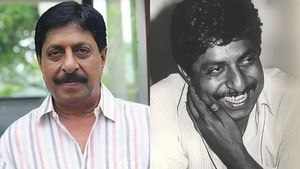 Sreenivasan Passes Away: Malayalam Cinema Mourns The Legendary Actor-Writer's Demise
 -
 Malayalam Film Industry Loses A Defining Voice: Actor, Screenwriter And Director Sreenivasan Passes Away At 69
 -
 Happy Birthday Dheeraj Dhoopar: How A TV Set Friendship Turned Into Love With Wife Vinny Arora
 -
 Top Skin and Hair Concerns in India in 2025: What the Data Reveals
 -
 International Human Solidarity Day 2025: History, Significance, and Why It Matters
 -
 Purported Video of Muslim Mob Lynching & Hanging Hindu Youth In Bangladesh Shocks Internet
 -
 A Hotel on Wheels: Bihar Rolls Out Its First Luxury Caravan Buses
 -
 Bharti Singh-Haarsh Limbachiyaa Welcome Second Child, Gender: Couple Welcome Their Second Baby, Duo Overjoyed - Report | Bharti Singh Gives Birth To Second Baby Boy | Gender Of Bharti Singh Haarsh Limbachiyaa Second Baby


Freedom From Pain (Vedanta and Pain II)

Vedanta Kesary, 1992 March, p.82-9
When the Upanishads, the Gita, and other Vedanta texts speak of pain and suffering (duhkha) they primarily refer to existential pain, and only secondarily to the pain that manifests at the physical and mental levels. An intense desire for spiritual liberation (Mumuksutva) sprouts in the heart when the seeker begins to feel the excruciating pangs of existential pain, and it is at this stage really that the spiritual quest begins in dead earnest.
If existential pain is inseparable from our existence as mortal, limited creatures, it naturally follows that this pain can disappear only when the 'mortal, limited creature' himself disappears. As we have seen, death is no solution, for the 'mortal, limited creature' still lives on, and so does his pain. Is there a way by which we may live on but our mortality and limitations would disappear? Indeed, there is, and it consists in consciously being what we really are. And there lies the crux of the problem. We do not know who we really are! This is bad enough. What is worse is that we have also assumed ourselves to be what we are not.
Our ignorance is, therefore, not merely the negation of knowledge but also the affirmation of a mysterious illusion which is neither real (sat) nor unreal (asat). So it is called mithya, meaning 'apparently real but really unreal.It is this peculiar kind of ignorance, a kind of self-hypnosis that makes us think of ourselves not as we really are but as limited creatures, born the other day and destined to die at some unspecified time in future.
Our real being has somehow become hopelessly identified with the body and mind. As a result all the limitations and characteristics of the body and mind seem to us to be our limitations and characteristics. The pain and suffering, which really belong to the body and mind, have somehow become our own! Trapped in this body-mind cage and fully identified with it, we appropriate for ourselves its pain; then we weep and wail, run here and there for relief from pain, and make our life a veritable hell.
"Thine only is the hand that holds The rope that drags thee on. Then cease lament, Let go thy hold..." says Vivekananda. Sounds simple enough! We have only to let go of our attachment and desires related to the body and mind and hey presto, all pain vanishes. But when we get down to business, things don't appear as simple as they did.
However much we may try to let go of our attachment and desires, somehow they seem to be most reluctant to let go of us! We may want to brush them aside, but they seem to cling on tenaciously. There is nothing to be surprised at this. We have pampered and nourished them for God alone knows how many millions of lives. They won't leave us easily. Human effort is not sufficient to drive them away. We need to make superhuman effort. And that, fortunately, is quite within our capacity.
The power that upgrades human effort to superhuman effort is lodged in our hearts. We have only to call it out. That needs singleness of purpose, extraordinary dedication, perseverance, patience, purity, and grit. When the sleeping power within our heart wakes up, the word 'impossible' gets obliterated from our vocabulary. This is a fiery power in which worldly desires, attachments, and ambitions burn away like bales of cotton. Everything perishable perishes, leaving behind the one and only imperishable Atman, the true Self. Pain and suffering, the products of the 'hypnotized' Self, automatically disappear when the process of dehypnotization is complete and the Self knows its true nature as Being.


 Continue with Google