




 Click it and Unblock the Notifications


Latest Updates
-
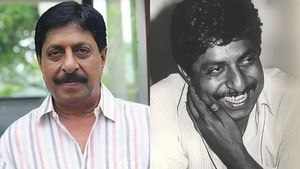 Sreenivasan Passes Away: Malayalam Cinema Mourns The Legendary Actor-Writer's Demise
 -
 Malayalam Film Industry Loses A Defining Voice: Actor, Screenwriter And Director Sreenivasan Passes Away At 69
 -
 Happy Birthday Dheeraj Dhoopar: How A TV Set Friendship Turned Into Love With Wife Vinny Arora
 -
 Top Skin and Hair Concerns in India in 2025: What the Data Reveals
 -
 International Human Solidarity Day 2025: History, Significance, and Why It Matters
 -
 Purported Video of Muslim Mob Lynching & Hanging Hindu Youth In Bangladesh Shocks Internet
 -
 A Hotel on Wheels: Bihar Rolls Out Its First Luxury Caravan Buses
 -
 Bharti Singh-Haarsh Limbachiyaa Welcome Second Child, Gender: Couple Welcome Their Second Baby, Duo Overjoyed - Report | Bharti Singh Gives Birth To Second Baby Boy | Gender Of Bharti Singh Haarsh Limbachiyaa Second Baby
 -
 Bharti Singh Welcomes Second Son: Joyous News for the Comedian and Her Family
 -
 Gold & Silver Rates Today in India: 22K, 24K, 18K & MCX Prices Fall After Continuous Rally; Check Latest Gold Rates in Chennai, Mumbai, Bangalore, Hyderabad, Ahmedabad & Other Cities on 19 December


World Gratitude Day 2021: Let's Learn About Gratitude From Saint Ramakrishna Paramahamsa


We all know that every year 21 September is celebrated as World Gratitude Day and therefore, so let's decode the true meaning of thank you and what gratitude really means from the great Indian Saint Ramkrishna Paramhansa.
Vedanta Kesary (1992, January p.2-5)
Gratitude
is
not
just
a
matter
of
a
thank-you
or
some
form
of
visible
acknowledgement
of
the
help
we
have
received.
These
are
outer
and
usually
superficial
ways
of
expressing
our
gratitude.
They
may
be
OK
and
sometimes
even
obligatory
as
a
form
of
social
etiquette,
but
they
need
not
necessarily
indicate
that
we
are
really
grateful.
It
is
possible
to
say
a
warm
thank-you
without
being
serious
about
it.
Obviously,
real
gratitude
must
proceed
from
the
centre
of
our
personality.
How
is
this
real
gratitude
expressed?
Through
love
and
reverence.
We
love
and
revere
not
only
the
benefactor
but
also
the
benefit
he
or
she
has
bestowed
on
us.
We
use
those
gifts
in
the
best
possible
manner,
for
ourselves
as
well
as
for
others.
Making
the
optimum
use
of
our
gifts
is
perhaps
the
best
way
to
be
grateful
for
the
gifts
received.
When
we
use
the
gifts
well,
the
message
is
loud
and
clear:
'I
care
for
your
loving
presentation.
I
am
grateful
to
you.
If we look back at our lives we'll be astonished to find what an enormous number of things there are we need to be grateful for. Let us begin with our parents, who were the first human beings we encountered as little babies. We could do nothing on our own then. We were fully dependent on them, particularly on our mothers. Have we cared to pause and ponder over their tireless, selfless labour, the continual sacrifices, and the unending care and love we received from them in those early years? They fed us, clothed us, nursed us back to health when we fell ill, and played with us. When we grew up a little, they arranged for our schooling and other facilities.
In the years that followed our parents were our constant source of support, encouragement, love, and security. How do we express our gratitude for all these things? It might be argued that our parents did everything because that is what they are supposed to do, it was their duty. We may appreciate their conscientiousness, but there is no question of being grateful for it. Now, that is an interesting point and it brings in a host of other related matters.
A group of Sikhs used to visit Sri Ramakrishna at Dakshineswar. They said to him once, 'God is compassionate.' Sri Ramakrishna smiled and asked them, 'To whom is He compassionate?' 'To all of us,' they said. 'But we are His children,' Sri Ramakrishna told them. 'Does compassion to one's own children mean much? A father must look after his children; or do you expect the people of the neighbourhood to bring them up?' Let us apply this insight to our earthly father and mother. We shall return to our Heavenly Father and Mother a little later.
So, then, our parents did their duty in bringing us up and, to that extent, there seems little meaning in thanking them for it. This may be a little difficult to understand for those in the West, for there one says thank-you all the time for every little thing. Their prayers to God are also profusely filled with expressions of gratitude. A day called the 'Thanksgiving' is set apart every year when believers offer special thanks to God for all the bounties He has bestowed on them. But the Eastern tradition is different. In India, no thanks are offered to God. No one says thank you to one's parents, teachers, children, and friends. Verbal thanking is considered a very formal gesture, tolerable in official dealings and among strangers, but not expected, even discouraged, in almost all other situations.
Once Sister Nivedita, by force of habit, said thank-you to a young Indian who had brought her a glass of water. She was quick to notice the subtle expression of pain on the young man's face, hurt as he was that the love and reverence with which he had done the little service to her was, so to say, compensated and neutralized by the two words: Thank You. She was careful thenceforth not to let this Western habit encroach on her dealings with those belonging to her adopted country.
About the author
Swami Tyagananda
Swami Tyagananda is a monk of the Ramakrishna Order and presently head of the Ramakrishna Vedanta Society in Boston.


 Continue with Google