




 Click it and Unblock the Notifications


Latest Updates
-
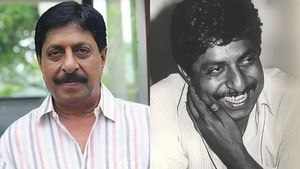 Sreenivasan Passes Away: Malayalam Cinema Mourns The Legendary Actor-Writer's Demise
 -
 Malayalam Film Industry Loses A Defining Voice: Actor, Screenwriter And Director Sreenivasan Passes Away At 69
 -
 Happy Birthday Dheeraj Dhoopar: How A TV Set Friendship Turned Into Love With Wife Vinny Arora
 -
 Top Skin and Hair Concerns in India in 2025: What the Data Reveals
 -
 International Human Solidarity Day 2025: History, Significance, and Why It Matters
 -
 Purported Video of Muslim Mob Lynching & Hanging Hindu Youth In Bangladesh Shocks Internet
 -
 A Hotel on Wheels: Bihar Rolls Out Its First Luxury Caravan Buses
 -
 Bharti Singh-Haarsh Limbachiyaa Welcome Second Child, Gender: Couple Welcome Their Second Baby, Duo Overjoyed - Report | Bharti Singh Gives Birth To Second Baby Boy | Gender Of Bharti Singh Haarsh Limbachiyaa Second Baby
 -
 Bharti Singh Welcomes Second Son: Joyous News for the Comedian and Her Family
 -
 Gold & Silver Rates Today in India: 22K, 24K, 18K & MCX Prices Fall After Continuous Rally; Check Latest Gold Rates in Chennai, Mumbai, Bangalore, Hyderabad, Ahmedabad & Other Cities on 19 December


Breaking Free-I


It is said that even a fool would not act unless there is something to be gained from it. Strangely those on the spiritual path keep slogging in a half-hearted way without any sense of direction. They are unaware of their spiritual evolution, unaware of the blossoming of life in all its fullness, which must follow all earnest attempt. This is, to say the least, a pity if one is on the Ramana path. For in this direct path the goal is clear from the beginning and the path too is unambiguous.
The goal is to be established in 'Sahaja Samadhi', the natural state and the way is self enquiry, an enquiry into the truth about oneself. Despite this clarity of both the goal and the means it would be false to suggest that all or even most of the practitioners of the Ramana way are anywhere near what is possible and must be gained, being the only core purpose of human life. Even the shining example of Ramana and his steady Self-abidance, and his repeated assurances about its universal accessibility seem lost on us.
Why? We seem to be constantly losing the battle with the past, which is the content of the mind, in the sense of latent tendencies and their proliferation as thoughts. Hence we find Ramana making remarks like "The past is our present misery", "All thoughts are sorrowful". Whether we can cut adrift from the past is the question which bogs down many. The task is regarded as well neigh impossible. One is ready to lose heart at the slightest pretext. 'Today I am not in a mood to meditate' 'My mind is wandering too much' are very common statements. We would still be vague even about the first principles of the Ramana Way and keep fumbling along wasting the golden opportunity to which divine grace has exposed us.
The
last
thing
that
one
should
do
is
to
begin
with
diffidence.
"Others
have
succeeded,
why
not
you?" Ramana
would
say.
Perhaps
one
would
do
well
to
remember
the
naturalness
of
the
Self-experience.
Somehow
one
is
firmly
rooted
in
the
belief
that
this
experience
can
only
be
at
some
distant
future.
This
is
precisely
what
would
happen
when
an
experience
which
can
only
be
in
the
now
is
wrongly
assumed
to
be
possible
only
at
some
future
date.
The
ability
to
stay
with
the
experience
would
grow
with
earnest
effort.
Unnoticed
but
ever
there
is
Ramana's
Presence
which
alone
can
make
for
fruition
of
these
efforts.
What seems to be the problem is that we tire too easily and are only too ready to throw up our hands without learning to cut ourselves free from the past by being focused on the 'I' thought and then on its source. Quoting Ramana 'Patience more patience' is what is needed. If you are watching the grueling five-setter match on the clay courts of Roland Garros you can readily see what it means to work at a thing in order to succeed.
A clay court specialist remarks "You need to understand what clay means. It means sacrifice, patience and you have to know that the ball may come back a million times. You have got to be ready for it". Here instead of the ball one might substitute the word 'thoughts'. They keep coming back in their endless succession for they are the response of stored up experiences of the past coming up in the course of our relationships and activity. We cannot say 'let the dead past bury its dead'. One is constantly stirring up the ashes of the past, by permitting thought invasions by inattention to their birth, to their surfacing, and failure to cling to the 'I' thought to be able to get back to the source.
Chat With The Devotees Of Bhagwan Ramana Maharishi


 Continue with Google