




 Click it and Unblock the Notifications


Latest Updates
-
 ‘Clean Air Is a Right, Not a Luxury’: ZONAIR3D Unveils India Expansion Plans
 -
 World Meditation Day 2025: Meditation Beyond The Mat, Simple Moments That Bring Inner Peace
 -
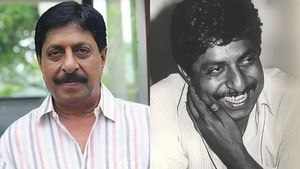 Sreenivasan Passes Away: Malayalam Cinema Mourns The Legendary Actor-Writer's Demise
 -
 Malayalam Film Industry Loses A Defining Voice: Actor, Screenwriter And Director Sreenivasan Passes Away At 69
 -
 Happy Birthday Dheeraj Dhoopar: How A TV Set Friendship Turned Into Love With Wife Vinny Arora
 -
 Top Skin and Hair Concerns in India in 2025: What the Data Reveals
 -
 International Human Solidarity Day 2025: History, Significance, and Why It Matters
 -
 Purported Video of Muslim Mob Lynching & Hanging Hindu Youth In Bangladesh Shocks Internet
 -
 A Hotel on Wheels: Bihar Rolls Out Its First Luxury Caravan Buses
 -
 Bharti Singh-Haarsh Limbachiyaa Welcome Second Child, Gender: Couple Welcome Their Second Baby, Duo Overjoyed - Report | Bharti Singh Gives Birth To Second Baby Boy | Gender Of Bharti Singh Haarsh Limbachiyaa Second Baby


Power Of The Mind - Part II

Let us look at what happens in practice. After a while one becomes dispirited and loses the flush of initial enthusiasm. Instead of 'joyously' pursuing sadhana, as suggested by Ramana in his 'Appalam Song', the slow paralysis of a dull and mechanical approach creeps in. To combat this Ramana's assurance about the inherent efficacy of the mantra, the name, the form and of course self-enquiry, has to be remembered. Potency for what? Of course for making the mind unitary or for eradicating the latent tendencies.
'One must therefore entrust himself to his mantra or God and wait for its grace'. One cannot be like the Kumbakonam devotees whose visit has been narrated by Santhamma graphically. These visitors were in a desperate hurry to catch the train by which they were booked. In the interval between their arrival and the scheduled departure of the train they pestered Ramana to bestow on them, quickly, the fruits of spiritual practice. They urged Ramana to hurry his ministration so that they may not miss the train. Small wonder, therefore, that Ramana would counsel the need for 'patience and more patience'. For, one cannot really say at what time the hard and intense spiritual effort would fructify.
It seems strange but true that we are ready to recognize the time factor in the ordinary things of life, say for instance that child birth would follow nine months of pregnancy, that plants would flower after a certain period and trees would bear fruit after some years, but when it comes to spiritual practice impatience and restlessness are allowed to gain ground.
Some try to push forward by redoubled effort for which they are not yet ready. Consequently we find them complaining to Ramana about head-ache and other bodily ailments when they attempt to concentrate for longer periods. Such consequences are danger signals of trying to force the pace or accelerating too soon.
That does not mean that one should be devoid of passion, be devoid of a strong urge to experience the bliss of 'the source', but it is only to suggest that things should be on an even keel. Neither can a tiger's prey escape its jaws nor can the Satguru's rescue operations fail.
Another common fear expressed is that effective spiritual practice is possible only in the atmosphere surrounding the physical proximity of the Satguru. Grant Duff used to complain about it when he was away from Sri Ramanasramam.
An English devotee echoing the general feeling expressed the fear whether it would be possible at all for her to be steadfast in practice at her home far away from the Maharshi. When such thoughts were expressed Ramana would remind that every one is free to remember his presence in the heart. Confidence in the time-space transcending, limitless nature of the Guru would enable one to invoke his presence wherever on may be, in whatever situation one may find oneself in life.
Given
this
confidence
in
the
Guru,
the
flame
of
longing
is
bound
to
remain
unflickering.
Who
can
then
be
stopped
from
the
joyous
trip
inward?
Who
can
be
denied
the
exhilaration,
the
bliss
of
the
inner
journey
itself?
The
tasting
of
such
bliss
would
make
one
return
for
more
of
the
experience,
till
at
last
the
bloom
of
life
bursts
forth
in
all
its
natural
fullness.


 Continue with Google