




 Click it and Unblock the Notifications


Latest Updates
-
 World Meditation Day 2025: Meditation Beyond The Mat, Simple Moments That Bring Inner Peace
 -
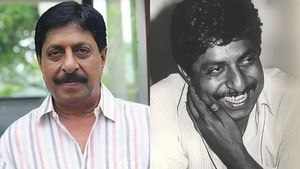 Sreenivasan Passes Away: Malayalam Cinema Mourns The Legendary Actor-Writer's Demise
 -
 Malayalam Film Industry Loses A Defining Voice: Actor, Screenwriter And Director Sreenivasan Passes Away At 69
 -
 Happy Birthday Dheeraj Dhoopar: How A TV Set Friendship Turned Into Love With Wife Vinny Arora
 -
 Top Skin and Hair Concerns in India in 2025: What the Data Reveals
 -
 International Human Solidarity Day 2025: History, Significance, and Why It Matters
 -
 Purported Video of Muslim Mob Lynching & Hanging Hindu Youth In Bangladesh Shocks Internet
 -
 A Hotel on Wheels: Bihar Rolls Out Its First Luxury Caravan Buses
 -
 Bharti Singh-Haarsh Limbachiyaa Welcome Second Child, Gender: Couple Welcome Their Second Baby, Duo Overjoyed - Report | Bharti Singh Gives Birth To Second Baby Boy | Gender Of Bharti Singh Haarsh Limbachiyaa Second Baby
 -
 Bharti Singh Welcomes Second Son: Joyous News for the Comedian and Her Family


Jagannath Rath Yatra 2023: Why Is Holding Rope Of Rath Yatra Considered Auspicious

In India, the Rath Yatra or the chariot festival is organised every year, especially in the eastern part of the country with great enthusiasm. On this day, Lord Jagannatha, which means 'Lord of the Universe' is worshipped in the city of Puri, and he is believed to be an avatar of Lord Vishnu.
This festival is celebrated at the famous Jagannath temple in Puri, Odisha and is observed on Dwitiya Tithi during the Shukla Paksha of the Ashada month according to the Hindu Lunar Calendar. Lakhs of devotees from around the world come here to visit the Lord.

As per the Gregorian Calendar, it usually falls in the month of June or July and this year, it will be celebrated on Tuesday, 20 June 2023. The Dwitiya Tithi begins at 11:25 am on 19 June 2023 and Dwitiya Tithi ends at 01:07 pm on 20 June 2023. Lord Jagannath will be taken out for the Ratha yatra on Tuesday, 20 June 2023 and this procession will start at 10.04 pm on this day. It will end on Saturday, 01 July 2023.
In an ancient religious text, Brahmanda Purana, it is mentioned that 'A person who sees the Lord's Ratha-yatra car festival and then stands up to receive the Lord can purge all kinds of sinful results from his body.' Another statement reads that 'Even if born of a lowly family, a person who follows the Ratha-yatra car when the Deities pass in front or from behind will surely be elevated to the position of achieving equal opulence with Visnu.'
Let us understand why touching or holding the rope of Rath Yatra is considered so auspicious.
Jagannath Rath Yatra 2023: Why Is Holding Rope Of Rath Yatra Considered Auspicious?
Jagannath temple of Puri is one of the most popular religious places in India and is one of the Char Dhams (holy places) which attracts major footfall due to spiritual reasons.
The unfinished idols of this temple- Lord Jagannath, brother Balabhadra and sister Subhadra has a fascinating legend behind them and they are made from wood and not from metal, straw and mud or stone. A neem tree is chosen to make these idols because the dark colour is associated with the deities. These idols embody a large, square-shaped head, big eyes and unfinished limbs and there is a popular legend behind it.
These idols are not changed every year but can be replaced only after the 8th, 12th and 19th year from the last replacement ceremony. This is because anything that is made of wood or spiritually speaking, anything that is made on the earth decays after some time and therefore, it needs a change.
The festival lasts for 15 days and the religious and cultural preparations begin quite early with the making of new chariots. Pulling the chariot or touching the rope is considered auspicious by many as there is a belief that the holy chariot of Lord Jagannath is the embodiment of the deity himself and it is his soul that lies inside the gods placed on the chariots.
This is the only time when the idols of the trinity are brought out from the temple premises, giving devotees a chance to catch a glimpse of their beloved deities. It is the wish of every devotee to touch or pull the rope that is fixed to the chariot.
There is a belief that by pulling or touching the rope, Lord Jagannath will free an individual from all their sins and relieve them from the cycle of rebirth. There is so much devotion that a few decades back, devotees used to sacrifice their lives by coming under the wheels of the chariot of Lord Jagannath. However, now stringent rules are implemented so that these unfortunate incidents can be avoided.
Spiritually speaking, the chariots represent the mind and the Lord teaches the devotees how to control one's mind in the journey of life or become the charioteer so that one can always find the right direction. Once, the Rath Yatra is completed, then the chariots are dismantled and used as firewood in the temple's kitchen for cooking.


 Continue with Google