




 Click it and Unblock the Notifications


Latest Updates
-
 A Hotel on Wheels: Bihar Rolls Out Its First Luxury Caravan Buses
 -
 Bharti Singh-Haarsh Limbachiyaa Welcome Second Child, Gender: Couple Welcome Their Second Baby, Duo Overjoyed - Report | Bharti Singh Gives Birth To Second Baby Boy | Gender Of Bharti Singh Haarsh Limbachiyaa Second Baby
 -
 Bharti Singh Welcomes Second Son: Joyous News for the Comedian and Her Family
 -
 Gold & Silver Rates Today in India: 22K, 24K, 18K & MCX Prices Fall After Continuous Rally; Check Latest Gold Rates in Chennai, Mumbai, Bangalore, Hyderabad, Ahmedabad & Other Cities on 19 December
 -
 Nick Jonas Dancing to Dhurandhar’s “Shararat” Song Goes Viral
 -
 From Consciousness To Cosmos: Understanding Reality Through The Vedic Lens
 -
 The Sunscreen Confusion: Expert Explains How to Choose What Actually Works in Indian Weather
 -
 On Goa Liberation Day 2025, A Look At How Freedom Shaped Goa Into A Celebrity-Favourite Retreat
 -
 Daily Horoscope, Dec 19, 2025: Libra to Pisces; Astrological Prediction for all Zodiac Signs
 -
 Paush Amavasya 2025: Do These Most Powerful Rituals For Closure On The Final Amavasya Of The Year


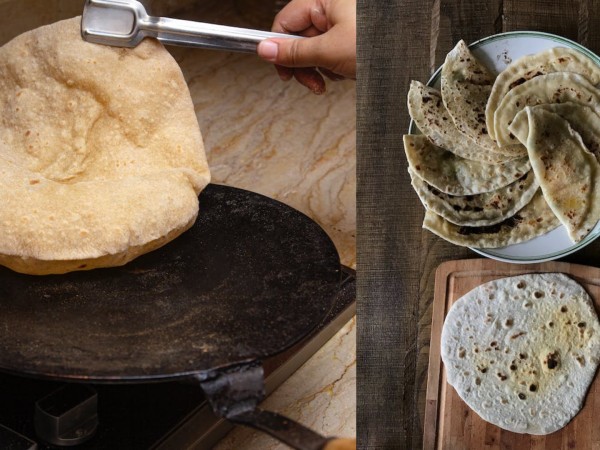
Why Are Indian Chapatis Always Rolled Round? The Reason Is Simple And Interesting!

Chapati, roti or phulka is a very popular staple food in India and one of the preferred options when it comes to lunch, dinner and even breakfast. Not only they are a highlight of our cuisine but form an essential part of our daily diet.
The term 'chappati' comes from a Hindi word 'chapat' which means 'slap', however, there is no connection but it can mean slapping the dough to make it thin.

Rotis are a flatbread made from stoneground wholemeal flour, which is traditionally known as atta and water that is combined into a dough. There are many variations and it is eaten in many countries. Grains like bajra, jowar, makki, ragi, besan ad even refined flour or a mix of wheat are used to make it.
Chapatis are primarily prepared using wheat flour and are paired with either dal, curry or sabzi. In different parts of India, chapati is prepared using a variety of grains like jowar, bajra, rajgira, ragi, makki, besan and even a mix of wheat flour & refined flour.
But, did it ever occur to you why it is round in shape? Are we naturally obsessed with the round shape or it is because we take the credit for inventing 0 (zero)? Not just roti, but even poori, dosa, chila, idli, paddu- everything is round in shape. We are not even going near the sweets, because it is mind-boggling because almost everything resembles a round shape.
So, making things that have no angles is easy or does the shape interfere anyway with how we approach food? We all agree that we eat with our eyes first and then with our mouths. Read on to know why chappatis are rolled round and what's the reason behind their circular shape.
- The primary reason behind making the roti round is that it is one of the easiest shapes to make or achieve. When the shape is circular and there are no angles, then it makes one's job easier while using a rolling pin (belan) and therefore, the edges can also be rolled out easily.
- Further, the round shape has benefits too when it comes to cooking. The food is cooked evenly when it is circular in shape and also if we are making it on tawa, which is usually round too, then it is an added advantage as well.
- Circle also represents the cycle of life and death, according to some religious beliefs. Also in some parts of this county, roti is given to deities as a part of spiritual practice and is believed to be a symbol of offering and sacrifice as well.
- According to Hindu mythology, when you feed the first chapati to the cow then it makes the position of Venus strong in one's life and shower them with good opportunities.
-
The
cooking
style
using
'tandoori'
which
became
famous
in
the
Mughal
era,
chapatis
saw
a
transformation
and
as
a
result,
we
see
'tandoori
roti'
on
our
plate.
These
were
widely
prepared
in
the
royal
court
of
the
Mughals
and
are
liked
due
to
their
crunchy
texture
and
smoky
aroma.

How
to
prepare
roti/chapati
Ingredients
required-
1
cup
wheat
flour
(250
grams),
1
pinch
of
salt
and
water
as
per
requirement.
Method-
1.
In
a
large
bowl,
add
wheat
flour
and
one
pinch
of
salt
and
water
and
start
kneading
the
dough
gently
and
slowly
using
your
hands.
2.
Add
small
amounts
of
wter
in
the
mix
and
use
your
palm
to
knead
it
till
the
dough
becomes
medium
soft.
3.
Take
a
few
drops
of
oil
and
smear
the
dough
with
it.
Use
a
damp
cloth
to
cover
it
and
let
it
rest
for
15-20
mins.
4.
Pinch
out
a
ball
of
dough
and
use
your
palm
to
make
it
round
and
then
use
a
rolling
pin
to
flatten
it
out
along
with
some
dry
flour.
5.
Once
done,
place
the
chapati
on
a
hot
tawa
and
let
it
cook
until
light
golden
patches
appear
on
its
surface.
6.
Once
the
patches
appear,
flip
it
towards
the
other
side
and
then
use
a
cotton
cloth
or
kitchen
towel
to
gently
press
the
sides
of
the
chapati.
7.
This
is
a
necessary
step
because
it
pushes
the
steam
inside
towards
the
centre
of
the
chapati
making
it
puff
up.
Once
it
puffs
up,
you
can
transfer
it
to
a
direct
flame
and
cook
it
from
all
sides.
8.
Your
Chapati
is
now
ready
to
be
served
with
veggies
or
curries
of
your
choice.


 Continue with Google